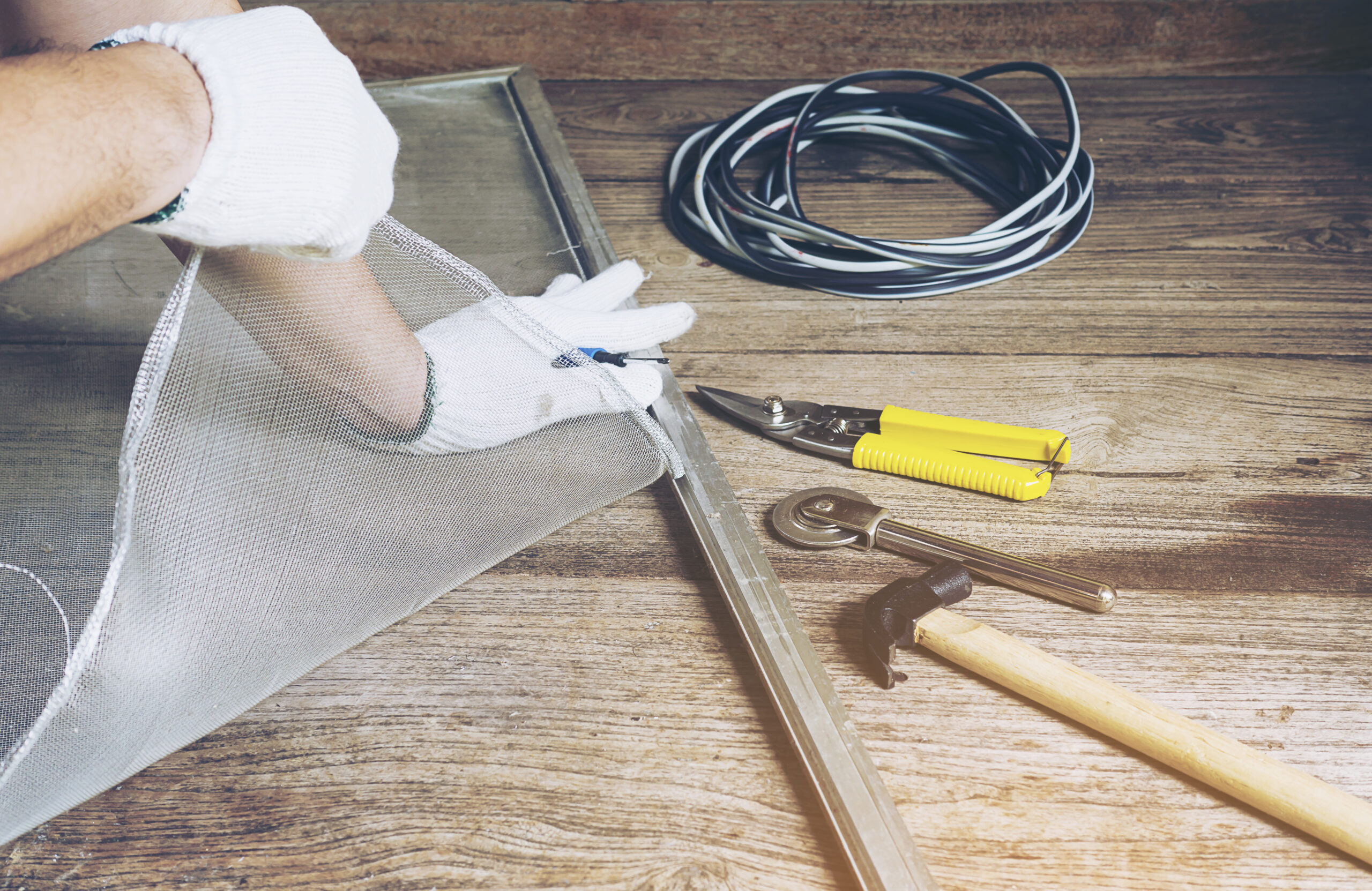

How to Repair a Torn Window Mosquito Net at Home
A torn window net can turn an otherwise comfortable evening into a frustrating one. You want to leave the window open for fresh air, but that small opening in the mesh gives insects another way inside. Closing the window solves one problem and leaves you with a warm, stuffy room.
To repair a small tear, clean and dry the mesh, cover the damage with a compatible screen patch, press it onto sound material around the hole, and let it set as directed. If the net is brittle, badly torn, or pulling away from the frame, inspect that problem before patching. A short split in soft, sewable netting may also be stitched closed.
A window mosquito net is also called an insect screen or flyscreen. This guide covers the mesh fitted across a window, rather than a mosquito net hung over a bed. The repair you choose depends on both the material and the damage, so begin with a close look before reaching for glue or scissors.
Inspect Your Window Mosquito Net Before Repairing It
Start in good daylight. Look across the whole screen rather than concentrating only on the most obvious hole. Check the corners, the bottom edge, and any area where the mesh meets the frame. A window can have an excellent patch in the middle and still let insects through a loose corner.
Next, examine the material around the tear. Support it gently with your hand instead of pulling it. If nearby strands break with light handling, the mesh may be too worn to hold a patch reliably. Repairing that one spot could simply move the problem a little farther along.
Identify the kind of damage you have:
- A puncture: a small hole with reasonably sound mesh around it.
- A split: a narrow opening where the material has separated.
- Missing mesh: a section has been torn away, leaving nothing to join together.
- A loose edge: intact mesh has slipped out of its fixing.
- Widespread wear: several holes, crumbling strands, or repeated failures across the panel.
Also notice what caused the damage. A sharp window handle, projecting screw, or rough frame edge may tear a fresh repair in the same place. Move the window carefully through its normal opening range and look for anything that catches the net. Fixing the cause is part of fixing the tear.
Choose the Right Window Mosquito Net Repair Method
There is no single hole size that decides every repair. The patch instructions, the strength of the surrounding net, and the position of the damage all matter. A modest hole in strong mesh is a better repair candidate than a smaller tear in material that falls apart when touched.
Use this table to narrow down your options before buying supplies.
| Condition of the net | Suitable approach | What to check first |
|---|---|---|
| Small hole in otherwise sound mesh | Compatible adhesive mesh patch | Patch must overlap strong material around the entire hole |
| Short slit in flexible, sewable netting | Gentle stitching or a sewn patch | Stitching must not enlarge the mesh openings |
| Small hole in metal screening | Compatible metal screen patch | Sharp wire ends must be secured safely |
| Intact net pulling away from the frame | Restore the original edge fixing | There must be enough undamaged mesh to secure |
| Large opening or several nearby tears | Replace the mesh panel | Check whether the existing frame can be reused |
| Cracked, bent, or loose frame | Repair the frame or seek fitting help | A patch cannot correct a frame that does not fit |
Think about appearance as well as function. A patch will usually be visible at close range, especially if its colour differs from the original mesh. That may be perfectly acceptable on a utility-room window. For a prominent front window, replacing the mesh could give you the finish you prefer.
Gather Materials for Your Window Mosquito Net Repair
For a basic patch, you will usually need scissors, a ruler, a soft cloth, mild soapy water, and a repair patch intended for insect screening. Choose a product labelled for the type of mesh you have and the conditions where it will be used.
Depending on the repair, you may also need:
- A small piece of matching insect mesh.
- A fine needle and suitable durable thread for sewable netting.
- A compatible screen adhesive if the patch instructions require it.
- Gloves for handling metal mesh or sharp frame edges.
- A spline roller and correctly sized spline for a grooved frame.
- A screwdriver suitable for the frame fittings.
Spline is the flexible cord pressed into a channel around some screen frames. It traps the mesh in place. Not every window uses it: other screens may be stapled to timber, held beneath wooden strips, or attached with removable fasteners.
Before visiting a hardware shop, take a clear photograph of the screen and its edge fixing. Record the dimensions of the damage and, if replacing the panel, the frame. Asking for a “mosquito net” alone may lead to bed-net fabric or another material that does not suit your window.
If you are shopping locally in Nigeria, show the photograph to an aluminium-window fabricator or building-materials seller and ask for window insect mesh or screen repair tape. Check the label before paying: wall-repair mesh and window-screen patches are different products. Keep the packaging so you can follow the application and setting instructions at home.
Prepare the Window Mosquito Net for a Neat Repair
If the screen is designed to come out, remove it carefully and place it on a stable work surface. Photograph clips, tabs, or screws before taking them apart. Put small fittings in a container so they do not disappear during cleaning.
For a fixed screen, work only where you can reach safely from inside. Avoid leaning through an open window or balancing on furniture to reach the outside. If the repair requires access you cannot manage securely, arrange help. Insect mesh should never be treated as something that will support your weight.
Gently clean the area around the tear. Dust can stop adhesive from making good contact, and grease near a kitchen window can leave an apparently neat patch poorly attached. Use a soft cloth and mild cleaning solution, remove the residue, and allow the mesh to dry fully.
Support the net while cleaning so that you do not stretch the hole. Remove only loose strands that interfere with the repair. There is no need to turn every irregular tear into a large square opening, particularly when a ready-made patch can cover it as it is.
Finally, place the patch over the damage before removing its backing or applying adhesive. This quick dry fit helps you check coverage, colour, and access. It is much easier to adjust the plan at this stage than after the patch has stuck to the wrong spot.
Patch a Window Mosquito Net With Adhesive Repair Mesh
An adhesive mesh patch is a straightforward option when the damaged area is small and the surrounding screen remains intact. Buy screening repair tape or a purpose-made patch, rather than assuming ordinary clear tape will perform the same job outdoors.
1. Measure and cut the patch. Measure the entire damaged area, including fraying. The patch must reach healthy mesh on all four sides. Follow the overlap specified on its packaging; do not cut it to the exact size of the hole.
For a practical sizing reference, Lowe’s recommends about 1 inch (2.5 cm) of overlap on each side for its adhesive fibreglass-screen patch method: Door & Window Screening Replacement Guide. With that allowance, a hole measuring 2 cm by 3 cm needs a patch about 7 cm by 8 cm. Use the requirement for your particular product if it differs.
2. Position the patch carefully. Hold the torn strands in their natural position without stretching them apart. Remove the backing as directed and centre the patch over the opening. Keep adhesive surfaces away from dusty fingers and the workbench.
3. Press it securely into place. Support the opposite side where accessible and press the patch according to its instructions. Pay particular attention to the perimeter. A loose corner can catch during cleaning and gradually lift the repair.
4. Allow the required setting time. Do not immediately wash, flex, or repeatedly poke the patch to see whether it is strong. Follow any temperature, drying, or curing conditions stated on the packaging.
Some patches use heat activation, while others are pressure-sensitive. Use heat only if the specific product requires it, and follow its directions. Never use a candle or lighter to melt the netting together.
After installation, look for folds or raised edges. If a corner will not stick, check for moisture, dirt, or insufficient overlap. Do not keep adding strips over a failing patch. Remove it as the maker directs, prepare the surface again, and use a fresh patch if the adhesive has become contaminated.
Sew a Small Tear in a Window Mosquito Net
Sewing is an option for soft, flexible netting that can accept stitches without breaking. It is less suitable for brittle screening or stiff metal mesh. If a needle or thread starts cutting through the surrounding strands, stop and choose another method.
For a short slit with no missing material, bring the two edges together gently. Anchor the thread in sound netting just beyond one end of the slit. Pass the needle through existing openings on alternating sides, working along the tear in small, even stitches. Pull each stitch only enough to bring the edges together; stop if the net puckers or the openings widen.
If material is missing, sew a matching mesh patch over the gap instead of pulling distant edges together. Cut it large enough to sit on healthy netting around the damage. Work around the patch in manageable sections, checking that it stays flat as you go.
Do not assume any household glue is suitable. If you use adhesive alongside stitching, check compatibility with the mesh and follow the product directions. Excess glue can leave a stiff, untidy area without improving the repair.
Finish beyond the other end of the tear, tying the thread securely without tugging on the mesh. Trim dangling thread and inspect the seam from both sides. If the edges will meet only when you pull hard, use a patch instead. A seam should close the opening without stretching neighbouring holes larger.
Repair a Metal Window Mosquito Net With a Compatible Patch
Metal screening needs a different approach from soft fabric netting. Cut wire can have sharp ends, so wear gloves and keep children away from the work surface. Choose a patch intended for the existing screen rather than trying to stitch metal with ordinary sewing thread.
Some metal patches have small hooks around their edges. These pass through the existing mesh and fold back to hold the patch in place. Follow the kit’s instructions for positioning and securing them, making sure the patch covers the opening completely.
Avoid aggressively pulling the metal into shape. Distorting the surrounding weave may create new openings or leave a raised patch that catches on curtains. Check both sides for loose or projecting ends before reinstalling the screen.
A metal repair should be secure without needing a large lump of glue to hold everything together. If the original mesh is corroded, breaking, or badly distorted, replacement is usually the more practical next step. The patch depends on the old material to carry it; it cannot restore strength to an entire worn panel.
Fix a Window Mosquito Net That Has Come Loose at the Edge
An edge gap is easy to mistake for a tear. Look closely before buying a patch: the mesh may simply have slipped out of the frame. In that case, covering the gap does not restore the attachment that is supposed to hold the whole panel.
On a removable spline-held frame, lay the screen flat and inspect the cord. For a small loose section:
- Carefully lift the affected length of spline without dragging a sharp tool across the net.
- Clear dirt from the exposed channel.
- Lay the intact mesh back over the groove, keeping its weave straight.
- Press serviceable spline into place with a spline roller, or replace deteriorated cord with a compatible size.
- Check that the mesh stays seated without bowing the frame.
This works only if enough undamaged mesh remains to reach into the groove. If several sides have come loose, removing and refitting the whole panel may be easier than making separate adjustments.
Do not force an oversized cord into the channel. A cord that drops in loosely may fail to grip. Take a sample of the old spline to the supplier, and mention any change in mesh thickness so the replacement can be matched to both the material and the groove.
Timber frames need a different assessment. Where the mesh is held under wooden strips or by staples, inspect those fixings and the wood itself. Loose trim, split timber, and exposed sharp fasteners need attention before fresh netting is attached.
If the net has torn directly along the fixing line, there may be too little sound material left to secure. Pulling the panel harder can make the tear spread. Replacing the mesh is preferable to stretching a damaged edge until it barely reaches the frame.
Replace a Window Mosquito Net When Patching Is Not Enough
Replacing the mesh does not necessarily mean replacing the entire window or even the screen frame. If the frame is sound and fits correctly, it may be reusable. This is worth checking before paying for a completely new assembly.
For a removable frame with a spline groove, the general process is:
- Remove the frame and lay it on a flat, stable surface.
- Lift out the spline and remove the damaged mesh.
- Clean the groove and check that the frame corners are secure.
- Lay new insect mesh squarely over the frame, leaving the supplier’s required margin on every side.
- Work around the frame with a spline roller, seating compatible cord and keeping the weave straight. Check corners carefully.
- Make sure the screen lies flat and the frame has not bowed. Correct wrinkles before trimming.
- Trim surplus mesh outside the secured spline, then refit the screen.
Phifer’s installation guide illustrates the spline-and-roller method and explains trimming toward the outside of the groove to avoid cutting the newly installed mesh: How to Replace a Window, Door or Patio Screen.
The finished panel should lie neatly without pulling the frame out of shape. If a side begins to bow, pause and correct the tension before cutting away the spare material. Once the excess is trimmed too closely, you have less room to undo a mistake.
Use extra care with a utility knife. Keep your supporting hand away from the cutting path, work on a stable surface, and do not rush the corners. If the frame uses an unfamiliar fastening system, get the correct instructions or ask a window fitter to handle that part.
Check Your Window Mosquito Net After the Repair
Hold a removable screen against a bright background or inspect a fixed one in daylight. Look for an unsealed patch edge, an uncovered part of the original tear, or a new opening created while handling the mesh. Check from a second angle if the overlapping layers make the patch difficult to see through.
Check the patch lightly after any required curing period. You are looking for lifting edges, not trying to pull it off. Then move the window through its usual range and confirm that handles, curtains, and sliding parts do not rub against the repair.
Inspect the frame corners and perimeter again. A screen that sits crookedly can leave a gap even when its mesh is perfect. Refit clips or other fittings correctly, and make sure the frame is seated as intended.
Clear away trimmed wire, needles, blades, and loose fasteners. Before putting your tools away, confirm three things: the patch has no lifted edges, the frame fits evenly, and the window opens without catching the net. Keep a small labelled offcut if you may need to match the material later.
Make Your Window Mosquito Net Repair Last Longer
Treat the mesh as a barrier, not a handle. Open and remove screens using their proper frame fittings. Repeatedly pushing the middle of the net to move it places unnecessary strain on both the mesh and its edges.
When cleaning, support the screen and use a gentle method suited to its material. Avoid scrubbing a repaired area with a stiff brush or pulling a cleaning cloth across a raised patch corner. Let the manufacturer’s care directions guide any cleaning products you use.
Keep objects from resting against the screen. A broom stored beside the window, a sharp plant support, or a piece of furniture can repeatedly press on the same spot. A quick rearrangement may prevent another tear more effectively than a larger patch.
Check the repair after cleaning or whenever you notice a lifted edge. There is no reliable universal lifespan for a patch: exposure, material quality, application, and handling all affect it. Respond to its condition rather than assuming it will last for a fixed number of years.
If you keep repairing the same area, reconsider the cause. The window may be catching the mesh, the frame may be poorly fitted, or the material may simply be worn out. Repeated patches are a useful sign that it is time to change the approach.
Window Mosquito Net Repair Questions Homeowners Often Ask
Can I use ordinary sticky tape?
It can cover a hole briefly if it adheres securely, but it is best treated as a temporary measure. A solid strip blocks airflow across that area and may leave residue. Choose a suitable screen patch for a planned repair, and check that any temporary covering remains attached.
Can I use spare fabric instead of mesh?
A solid fabric patch may cover the opening, but it reduces ventilation at that spot and may be harder to secure neatly. Matching insect mesh is usually a better choice. Avoid decorative netting with openings larger than the screen you are repairing.
Can I fix the screen without removing it?
Often, yes, if the damaged area is safely reachable and the patch can be supported and attached properly. Removal makes inspection and positioning easier, but it is not worth forcing a frame that is not designed to come out that way.
How much should I spend on the repair?
Compare the materials you actually need with the cost of replacing the mesh. Ask a local hardware seller or window fitter for a current quote using your measurements. For several damaged windows, buying a larger piece of suitable mesh may make more sense than purchasing individual patches for every opening.
Will a repaired screen stop every mosquito entering the house?
A properly closed repair removes that particular opening, but mosquitoes may still enter through doors, other damaged screens, or gaps elsewhere. Check the other windows too. Repairing one screen should not be taken as proof that the whole room is sealed against insects.
Finish Your Window Mosquito Net Repair With a Secure Fit
The best repair is the one that suits the damage and leaves the entire screen properly fitted. Patch a small hole in strong material, sew only netting that can tolerate it, and restore loose edge fixings instead of covering them blindly.
When the mesh is brittle or badly torn, replacing the panel can save the frustration of repeated repairs. Start with a careful inspection, choose compatible materials, and take your time with the edges. A neat patch matters, but a window with no remaining gaps is the result you are working toward.